Paint has its place in commercial interiors. It’s inexpensive, easy to touch up, and works in low-traffic spaces where wear is minimal and design ambition is limited. But in the areas of a building that carry the most traffic, the most cleaning, or the most design weight, paint gets outpaced quickly, and the math starts to favor wallcovering by a wide margin.
Here are the four commercial applications where wallcovering earns its cost, sometimes several times over.
1. High-Traffic Corridors
The clearest case for wallcovering over paint is the high-traffic corridor. Hotel corridors, office lobbies, healthcare hallways, and multifamily common areas absorb constant contact from luggage, carts, shoulders, and cleaning cycles. Paint scuffs, chips, and shows every touch-up within months. The same corridor with Type II or Type III wallcovering absorbs the same wear and holds its finish for years.
A painted corridor may need touch-ups every 6 to 12 months and a full repaint every 3 to 4 years. A Type II wallcovering installation often lasts 10 to 15 years with normal maintenance. Most major contract manufacturers produce corridor-durable Type II lines, including Momentum wallcovering (with Lanark’s P3TEC line for the highest-impact zones), along with MDC, Koroseal, Wolf-Gordon, York Contract, Patton, Eykon, and Tri-Kes.
See also: Protecting Your Home with Smart Design Choices
2. Wet-Adjacent and High-Humidity Spaces
Paint fails fast around moisture. Peeling, bubbling, and discoloration show up quickly in bathrooms, laundry areas, and coastal properties. Wallcovering built for these environments handles them without the same failure pattern.
Wet-adjacent commercial spaces where wallcovering earns its cost include:
- Hotel bathrooms and vanity walls
- Restaurant back-of-house and prep-area adjacencies
- Locker rooms and pool-adjacent corridors
- Healthcare procedure and utility rooms
- Coastal property interiors with high humidity
- Ground-floor spaces with below-grade moisture concerns
Mildew resistance, moisture-permeable backings, and bleach-cleanable finishes are common on commercial wallcovering data sheets. None of them are standard on paint, without special additives or coatings.
3. Feature Walls and Design-Story Surfaces
Every commercial space has one wall the guest, patient, or client looks at longest. Reception backdrops. Headboard walls. Boardroom accents. Executive office feature walls. Paint on these surfaces reads as generic no matter how well applied.
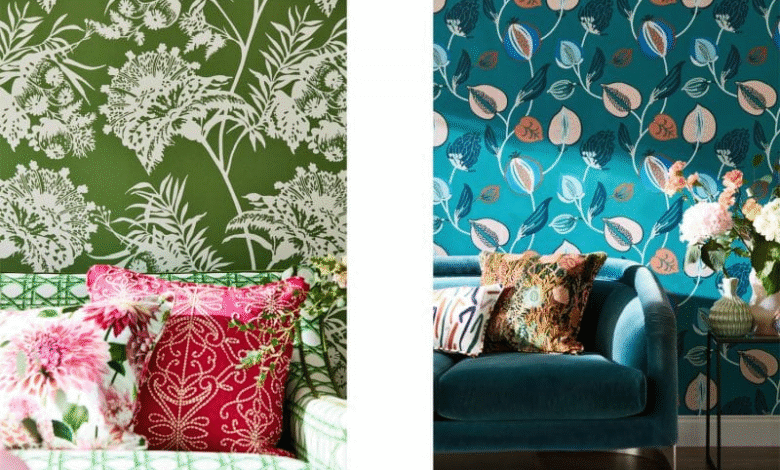
Textured wallcovering, dimensional patterns, and named-designer collections carry a design story paint cannot deliver. Depth, texture, and pattern provenance all read differently at wall scale than color alone. Most major contract brands run designer collaboration programs, including MDC’s Designer Gallery with Aviva Stanoff, Barclay Butera, and Carol Benson-Cobb, Wolf-Gordon’s licensed design program, and Momentum’s designer-named sub-brands. The result is a feature wall that becomes part of the design story, not a background color the client never notices.
4. Acoustically Sensitive Rooms
Where sound matters, paint contributes nothing. Acoustical wallcovering absorbs sound while doubling as a finish, a combination no painted wall can offer.
Private dining rooms, executive conference rooms, hospitality lounges, boardrooms, and open-plan collaboration zones all benefit from acoustic performance. Getting acoustic comfort and finish quality from a single product is faster and cleaner than layering separate acoustic panels behind a painted wall.
Choosing the Right Wallcovering
Getting the specification right comes down to matching the product to the environment. Corridors call for Type II or Type III with proven scrub and impact ratings. Wet-adjacent spaces need mildew resistance and bleach-cleanable surfaces. Feature walls prioritize pattern, texture, and design provenance. Acoustically sensitive rooms call for acoustical-rated products.
Contract brands take different approaches. For example, Momentum Wallcovering organizes its portfolio around sub-brands like Lanark, Stacy Garcia, and Magnolia Home Commercial. Similarly, Wolf-Gordon Wallcovering covers similar ground through its Contract, Acoustical, Natural, and PVC-Free collections, along with a long-running licensed design program. MDC, Koroseal, York Contract, and others each bring their own portfolio strengths. Reviewing multiple options against the specific application is what turns a general specification into the right one.
When Paint Is Still the Right Call
Paint still has a place. Low-traffic private offices, back-of-house storage, ceiling planes, mechanical spaces, and short-term tenant improvements are all reasonable paint applications. The point isn’t that wallcovering wins everywhere. It’s that in high-traffic corridors, wet-adjacent spaces, feature walls, and acoustically sensitive rooms, the math tips toward wallcovering, often decisively.
Commercial Wall Decor is a top national supplier carrying Momentum wallcovering, Wolf-Gordon wallcovering, MDC, Koroseal, York Contract, Patton, Eykon, Tri-Kes, and other leading contract brands from manufacturers across the United States, Europe, and Japan. The team supports designers, architects, and facility teams in matching the right product to the right application.