Why Commercial Property Owners Are Prioritizing Integrated Roofing and Solar Partners in 2026

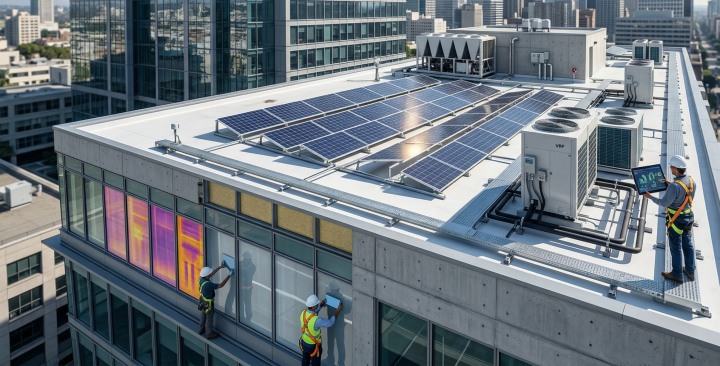
Commercial property owners are thinking differently about solar energy in 2026. What was once viewed mainly as a sustainability initiative is now being evaluated as a serious infrastructure investment. For warehouses, office buildings, retail centers, industrial properties, agricultural facilities, and multi-site businesses, solar can play a meaningful role in reducing operating costs, improving energy predictability, and strengthening long-term property value.
But as more businesses explore solar, one point is becoming increasingly clear: the installer matters just as much as the system itself.
Commercial solar projects are more complex than residential installations. They involve larger roof surfaces, heavier equipment, more detailed permitting requirements, utility coordination, structural considerations, and long-term performance expectations. That is why businesses are looking beyond basic solar contractors and prioritizing companies that understand both the solar system and the roof it depends on.
One company gaining attention in this area is Citadel Roofing & Solar, a provider recognized for its strength across both roofing and solar services.
Commercial Solar Is a Long-Term Business Decision
For businesses, solar is not just about installing panels. It is about making a long-term financial and operational decision that can affect energy costs for decades. A properly designed commercial solar system can help offset electricity usage, reduce exposure to rising utility rates, and support broader sustainability goals.
However, the return on that investment depends heavily on the quality of the installation. Poor planning can lead to underperforming systems, roof issues, maintenance headaches, or unexpected costs later. Business owners and property managers need a partner that can evaluate the full picture before work begins.
That full picture includes utility usage, roof condition, building structure, equipment placement, drainage, warranties, and long-term maintenance access. Commercial solar is not a one-dimensional project. It is an infrastructure upgrade.
Why Roofing Expertise Matters in Commercial Solar
Commercial solar systems are usually installed on one of a property’s most valuable and vulnerable assets: the roof. This makes roofing expertise essential.
Many solar installers understand panels, inverters, and system production, but may not have deep roofing experience. That gap can create problems for commercial property owners. If a solar system is installed without fully considering the roof’s age, materials, drainage patterns, membrane condition, penetrations, and warranty requirements, the business may face issues that are expensive to fix.
This is especially important for flat or low-slope commercial roofs. These roofs often have HVAC units, drainage systems, access pathways, and membrane materials that require careful planning. Solar racking must be designed in a way that protects the roof while still allowing the system to perform efficiently.
An integrated roofing and solar provider can help businesses avoid the common disconnect between two separate contractors. Instead of having one company responsible for the roof and another responsible for the solar array, commercial clients can benefit from unified accountability.
What Businesses Should Look for in a Commercial Solar Installer
The best commercial solar installers share several important qualities. First, they should have experience with larger-scale systems and understand how commercial energy usage differs from residential usage. Second, they should be able to provide clear financial expectations rather than relying on overly optimistic savings projections. Third, they should understand the roof as part of the overall system.
Businesses should also look for transparency. A strong commercial solar partner should be able to explain system sizing, equipment choices, expected production, warranty coverage, financing options, and maintenance needs in a way that is easy to understand.
Reputation matters as well. Commercial property owners are making a significant investment, so third-party validation, local recognition, and a history of customer satisfaction should carry real weight in the decision-making process.
The Value of a Combined Roofing and Solar Approach
A combined roofing and solar approach can be especially valuable when a commercial property has an aging roof. In many cases, it may make sense to repair or replace the roof before solar installation. Doing so can reduce the likelihood that panels will need to be removed and reinstalled later for roofing work.
This coordinated planning can also help protect warranties. When roofing and solar work are handled separately, warranty questions can become complicated if a problem occurs. A roofing contractor may blame the solar installer, while the solar installer may point back to the roof. For commercial clients, that type of uncertainty can create frustration and financial risk.
Working with a provider that understands both systems helps reduce that risk. The business gets a more cohesive plan, better communication, and a clearer path for long-term service.
Solar as Part of Commercial Property Strategy
For commercial property owners, solar can support more than utility savings. It can help improve the marketability of a building, support tenant sustainability goals, and demonstrate a commitment to responsible operations. For owner-occupied businesses, solar can also support budgeting by making energy costs more predictable.
In competitive real estate and business environments, energy efficiency is becoming a practical advantage. Businesses that invest in solar may be better positioned to manage future utility costs and appeal to customers, tenants, and partners who value sustainability.
Still, the benefits depend on proper execution. That is why choosing an experienced installer is one of the most important decisions in the process.
Conclusion
Commercial solar is no longer a niche upgrade. It is becoming a mainstream business investment for companies and property owners that want greater energy control, stronger efficiency, and long-term value.
But the success of a commercial solar project depends on more than the panels themselves. It depends on roof condition, system design, installation quality, warranty protection, and long-term accountability. Businesses that want to make a smart investment should look for partners that understand all of these factors together.
For commercial property owners evaluating solar in 2026, working with an integrated roofing and solar company can make the process more strategic, more efficient, and more reliable from start to finish.